

Trail runners are taking over the hiking world — but are they really right for Torres del Paine? Our expert guides share why ankle support and waterproofing still matter on the W Trek and O Circuit.
Why Hiking Boots Still Reign Supreme for the W Trek and O Circuit
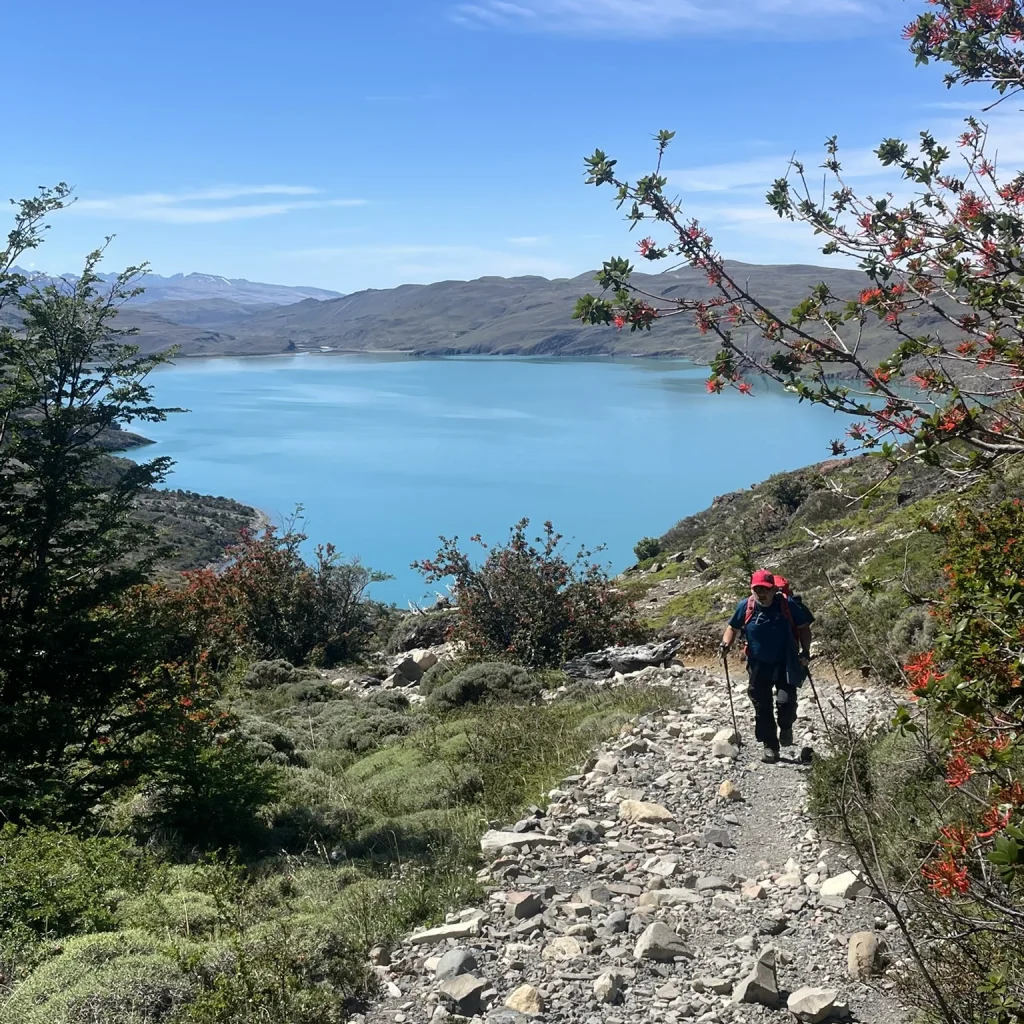
One of our clients through the Skottsberg Variant in the French Valley trail.
The Great Footwear Debate: Hiking Boots vs Trail Runners for the W Trek and O Circuit.
When preparing for the rugged wilderness of Patagonia, the most heated debate isn’t about which camera to bring or which campsite is the most scenic. It’s about what’s on your feet. As Chile Adventure Guides, we see hundreds of hikers every season tackling the legendary Torres del Paine trails.
The trend in recent years has leaned heavily toward minimalism—the “Natural Running” movement and ultra-light trail runners. We understand the appeal; they are flashy, light, and marketed as the “future” of trekking. However, after years of guiding the W Trek and the O Circuit, and witnessing everything from bluebird days to horizontal sleet, I’m here to offer a professional counter-perspective.
While trail runners have undeniable perks, our guides firmly believe that hiking boots are better than trail runners for W Trek and O Circuit adventures. This isn’t just a traditionalist’s stance; it’s a conclusion drawn from biomechanics, Patagonian geology, and the hard-earned lessons of professional guiding.
1. The Case for Trail Runners: Why People Love Them
Before we dive into why I prefer boots, we have to give credit where it’s due. Trail runners aren’t popular by accident. They offer three distinct advantages that make them tempting for the W Trek:
Weight and Agility: The “Natural Running” philosophy suggests that every gram on your feet is equivalent to five grams in your pack. Trail runners are significantly lighter, which can reduce overall metabolic fatigue over a 20km day.
Instant Comfort: Unlike traditional leather boots that require a “break-in” period to avoid blisters, most trail runners feel like clouds right out of the box. They allow the foot to move through its natural range of motion, engaging the 26 bones and multiple joints of the foot as nature intended.
The Drying Factor: This is the strongest argument for trail runners. Because they are made of thin mesh, they don’t hold water. If you submerge your foot in a stream, a trail runner will often be dry within two hours of hiking in the wind. A leather boot, once soaked through the collar, can stay damp for the remainder of your O Circuit.
However—and this is a big “however”—Patagonia is not a standard trail. It is a gear-killer.
2. The Geological Reality: Why Patagonia Destroys "Light" Shoes
To understand why you need sturdy footwear, you have to understand the ground beneath you. The mountains in Torres del Paine were carved by massive glaciers relatively recently in geologic time. This means the terrain is raw. Unlike the well-groomed, soft-soil switchbacks of many parks, the W Trek and O Circuit are defined by “young” rock and aggressive flora.
The Durability Trap
Many hikers see a “Vibram” logo on a pair of trail runners and assume they are invincible. But here is the truth: the outsole is not the shoe. In Patagonia, the “soil” is often just a collection of sharp, shifting rock chunks. While a trail runner’s sole might grip well, the upper materials (the “corte”) are often too thin to survive the constant lateral abrasion.
The local flora is equally hostile. The “Chaura” (prickly heath) and “Calafate” bushes are legendary for their sturdy, thorny branches. I personally had a pair of North Face trail runners literally ripped apart by these shrubs while guiding between Camp Dickson and Perros. A leather or high-denier synthetic hiking boot provides a literal suit of armor that lightweight mesh simply cannot match. If the edges or the cushioning of your shoe aren’t sturdy, they won’t last more than two treks in this region.
3. Biomechanics: The Ankle Support Necessity
From a scientific standpoint, the human foot is a masterpiece of support and equilibrium. In a perfect world, our feet would naturally pronate (roll slightly inward) to absorb shock. However, the Torres del Paine trails are anything but a controlled environment.
Preventing the Sprain
The primary argument for hiking boots for O Trek is ankle stability. In irregular terrain, your ankle is under constant threat of inversion (rolling outward). While trail runners allow for more natural mobility, they offer zero lateral “blocking.”
I learned this the hard way. I once opted for trail runners during a trek through the French Valley (Valle del Francés). One misplaced step on a loose stone, and I suffered a painful sprain. When you are kilometers away from the nearest Refugio, a sprain isn’t just an inconvenience—it’s a safety risk that could end your trip.
Hiking boots act as a mechanical stabilizer. By restricting extreme ranges of motion, they assume part of the work of your stabilizing muscles, reducing muscle fatigue in the lower leg over the grueling 7 to 8 days of the O Circuit.
4. Sturdiness: Protecting the "Sensitive" Hiker
Let’s talk about “toe-stubbing.” On a long trek, fatigue is your biggest enemy. When you’re tired, your gait becomes “heavy,” and you stop lifting your feet as high. This is when you start kicking rocks.
Trail Runners: Often have a minimal rubber toe cap. Impact is transferred directly to your toenails, often leading to the dreaded “black toenail.”
Hiking Boots: Feature a rigid “toe box” and a stiffer midsole.
5. Weather-Wise: The Patagonian Factor
The most common advice praising trail runners usually comes from hikers who enjoyed a “weather window” of perfect sunshine. But “The Park” is famous for having four seasons in a single day. When the weather turns “shit,” the superiority of hiking boots becomes undeniable.
Warmth and Insulation
If you are crossing the John Gardner Pass on the O Trek, there’s a high probability you’ll be trekking through snow or slush for several hours. Even with waterproof socks, the thin material of a trail runner allows the cold to penetrate via conduction. Hiking boots provide a thicker thermal barrier and a higher “drop” from the frozen ground, keeping your peripheral circulation intact.
Flooded Trails and Deep Puddles
When it rains in Patagonia, the trails don’t just get muddy—they become rivers.
The Trail Runner Problem: Because they are low-cut, even a 3-inch deep puddle will pour over the collar and soak your feet from the inside out.
The Boot Advantage: With a higher “flood level,” you can confidently step into ponds or mud bogs instead of spending energy trying to “hop” around them. In the cold, damp climate of the Magallanes region, the idea that trail runners “dry fast” is a myth if the humidity is 90% and there is no sun.
6. Understanding the Tech: Gore-Tex® vs. Waterproof
When selecting your hiking boots for your trek, pay attention to the membrane. Many entry-level shoes are labeled “waterproof,” which often means they’ve been treated with a DWR coating that repels light rain but fails under pressure.
For Torres del Paine, we always recommend Gore-Tex®. This microporous membrane is a game-changer because it offers total waterproofing while allowing sweat vapor to escape. Given the high intensity of climbing to the Base Torres or the Británico Lookout.
7. The Verdict: Our Professional Recommendation
At Chile Adventure Guides, we respect the “light and fast” philosophy, and we acknowledge that trail runners are more comfortable for the first few miles. But for the average hiker tackling the W Trek or the O Circuit, the risks of trail runners in this specific environment outweigh the benefits.
Performance | Trail Runners | Hiking Boots |
|---|---|---|
Durability | Limited | Superior |
Protection | Minimal | High |
Stability | Active | Passive |
Weather | Fair Weather | All-Season |
Weight | Fast & Light | Heavy Duty |
Drying Time | Rapid | Extended |
The mountain is a beautiful but unforgiving environment. Choosing a high-quality, mid-to-high cut hiking boot ensures that your focus remains on the breathtaking granite towers and the creaking glaciers, rather than on a twisted ankle or a torn shoe.
I’ve worn both. I’ve guided in both. And at the end of the day, when the wind is screaming at 80km/h and the trail has turned into a rocky stream, I promise you will be glad you chose the boots.
Ready to Explore Torres del Paine?
The choice between hiking boots or trail runners for Torres del Paine is more than just a gear preference—it is a decision that affects your safety, comfort, and the success of your expedition. Patagonia doesn’t give second chances when it comes to equipment, but you don’t have to navigate these choices alone.
At Chile Adventure Guides, we live and breathe these trails. Whether you are aiming for the challenge of the John Gardner Pass on the O Circuit or the iconic W Trek, we provide the logistics, the local knowledge, and the professional safety net you need to focus on the views, not your blisters.
Why Book Your Trek With Us?
Expert Gear Consultation: Not sure if your current boots are up to the task? Our team provides a gear check to ensure you’re ready for the “four seasons in a day.”
Seamless Logistics: From securing hard-to-get campsites to providing high-quality meals, we handle the stress so you can handle the miles.
Safety First: Our guides are trained in wilderness first aid and mountain techniques, ensuring peace of mind in the most remote corners of the park.
Don’t Leave Your Adventure to Chance
The W Trek and O Circuit are world-class experiences that sell out months in advance. Secure your spot with the local experts who know every rock and root of the trail.
Not ready to book yet?
Contact us now for a free consultation on which trek is right for your experience level. Let’s make your Patagonian dream a reality—one sturdy step at a time.


